by Miquel Farré
For the past several months, we’ve been pretty quiet about what we’ve been building at Studio Jadu.
That was intentional.
There is no shortage of people talking about what AI might do for entertainment, with a lot of excitement about how the latest GenAI models create amazing spectacles with ease. While “production” may be at the forefront for most, we’re focusing on the business of entertainment. In this post, we’ll talk about how the biggest challenge, and the biggest opportunity, lies in rethinking the entire process end to end: from concept to production to distribution to monetization..
We’ve invested significant time working alongside creators to build, learn, rethink, and rebuild, so we are able to shape the future of entertainment to not only give creators control over their stories, but also a good fighting chance to get those stories to audiences.
One thing has been clear to me since we started Studio Jadu:
AI is going to change much more than how entertainment gets produced.
For most of the history of animation, bringing an original character or world to life required an enormous amount of capital, specialized labor, and infrastructure. That meant countless great ideas never made it past the idea stage.
AI changes those economics dramatically.
An independent artist can increasingly do things that once required an entire studio. That is a profound shift! But it doesn’t automatically produce a better entertainment ecosystem. In some ways, it creates an entirely new set of problems.
Production is simply where the disruption is easiest to see first. But as someone who spent years in monetization of entertainment, building products that generate revenue from and for creators, I always look at the end-game: how will we build an enduring and sustainable business for all stakeholders, first and foremost for the artists whose creativity fuels the entire ecosystem? That North Star led us to critical decisions about how we shape Studio Jadu’s offering.
Let’s dive in.
A lot of the AI conversation today revolves around creation, e.g. Which model produces the best video? Which workflow is fastest? How much cheaper can production become?
Those are useful questions. They’re just not the only ones that matter.
Because after you make something, you still have to get somebody to care about it. And if dramatically more people can create dramatically more content, attention becomes even scarcer. This is the part of the AI entertainment transition that I think gets underestimated.
Democratizing production does not automatically democratize distribution.
A creator can make a beautiful character and still have no idea how to find the first thousand people who care about it. They can make a great episode and never turn a viewer into someone who comes back for the next one. They can accumulate views without building a fandom. And they can build a fandom without having a meaningful way to participate in the economic value that fandom creates.
Those are not separate problems to us.
They are the problems we started Studio Jadu to solve.
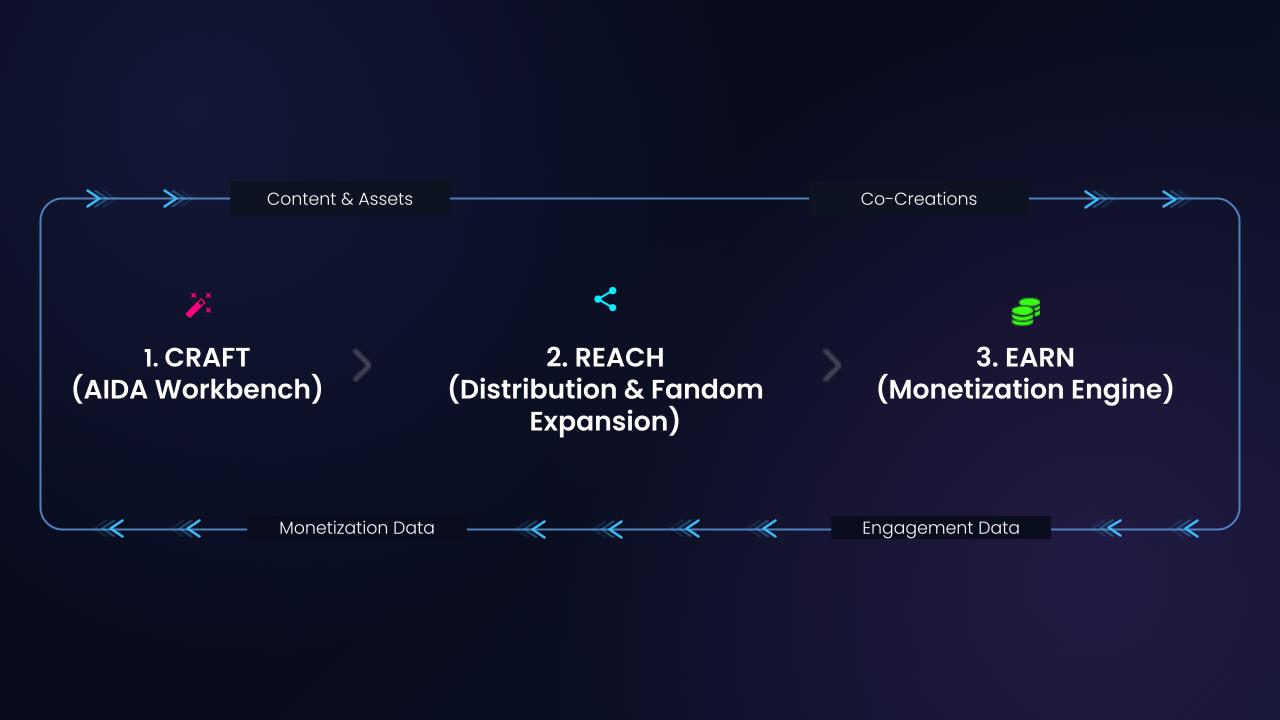
We’ve been building Jadu around three connected parts of the entertainment business: production, distribution, and monetization.
On the production side, our goal is to empower artists to bring their story to life with as much creative control as possible. We don’t believe GenAI can originate stories that will resonate with viewers. Artists can. We believe that our limitations, our very mortality, is what makes the most beautiful art possible.
Machines don’t get that. Audiences do.
This is more than just a philosophical musing. We are running a business that backs artists and their stories. And we believe that slop will have no commercial value, regardless of how cheap it is to produce it. So we want artists who have a strong point of view, great taste, and are ready to sweat over the details. To serve them, we’ve built a system that gives them the control they need to create original characters in amazing new worlds that audiences will fall in love with.
AI can generate, but only artists originate.
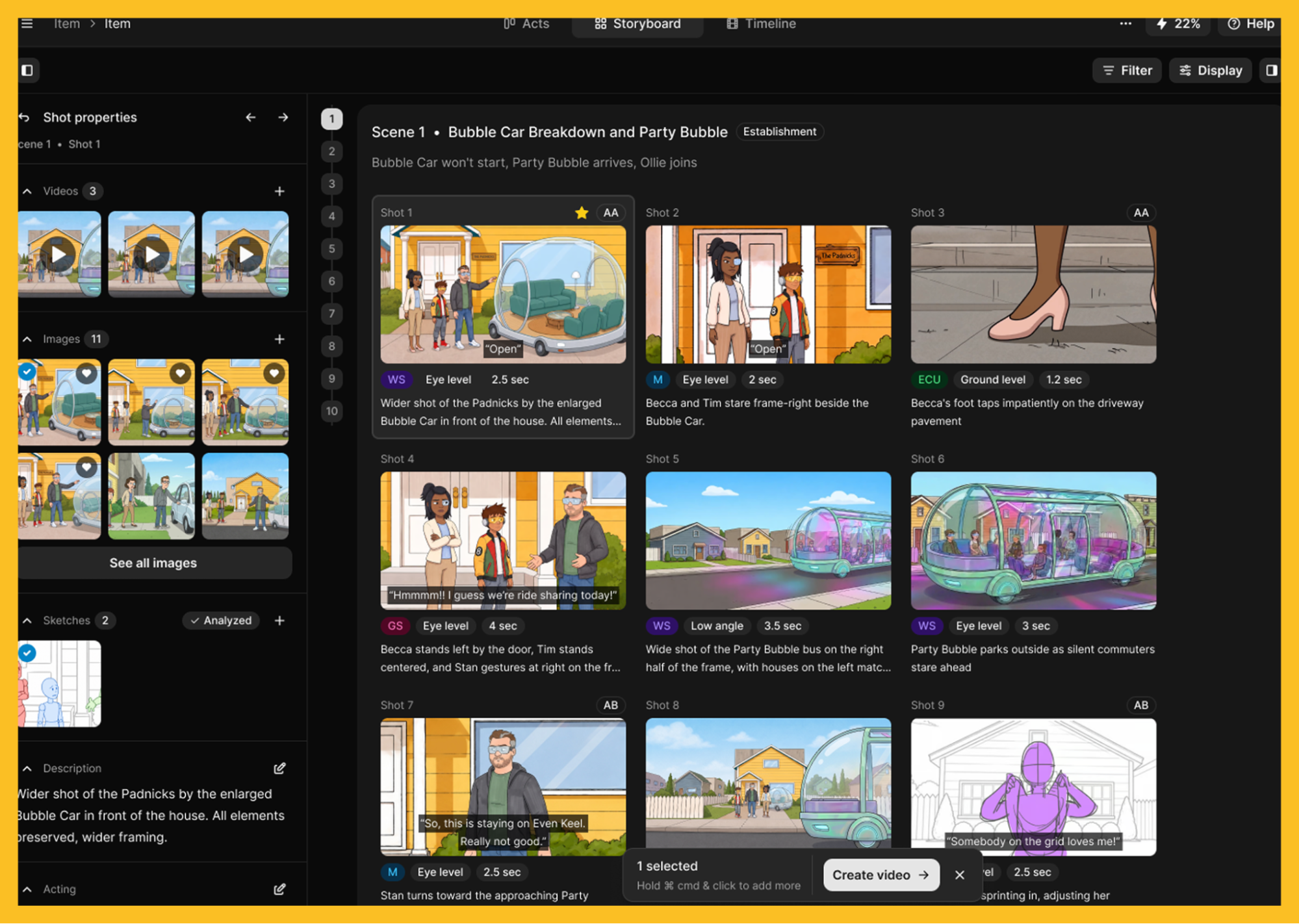
Every decision in the design of our production workbench, called AIDA (short for AI Director’s Assistant), was made with that principle in mind. For example:
But production is just the beginning. Once a creator has something worth watching, another challenge begins.
Studio economics were historically built around scarcity. There were relatively few organizations capable of producing and distributing high-quality entertainment at scale.
That world is disappearing.
When production becomes abundant, distribution becomes more important, not less. And we think distribution itself is going to change.
The most interesting creators don’t simply accumulate viewers. They create characters and worlds people want to return to. Over time, those audiences become communities. And the most engaged members of those communities don't necessarily want to remain passive consumers. They want to participate. That idea has been part of Jadu’s DNA since the beginning.
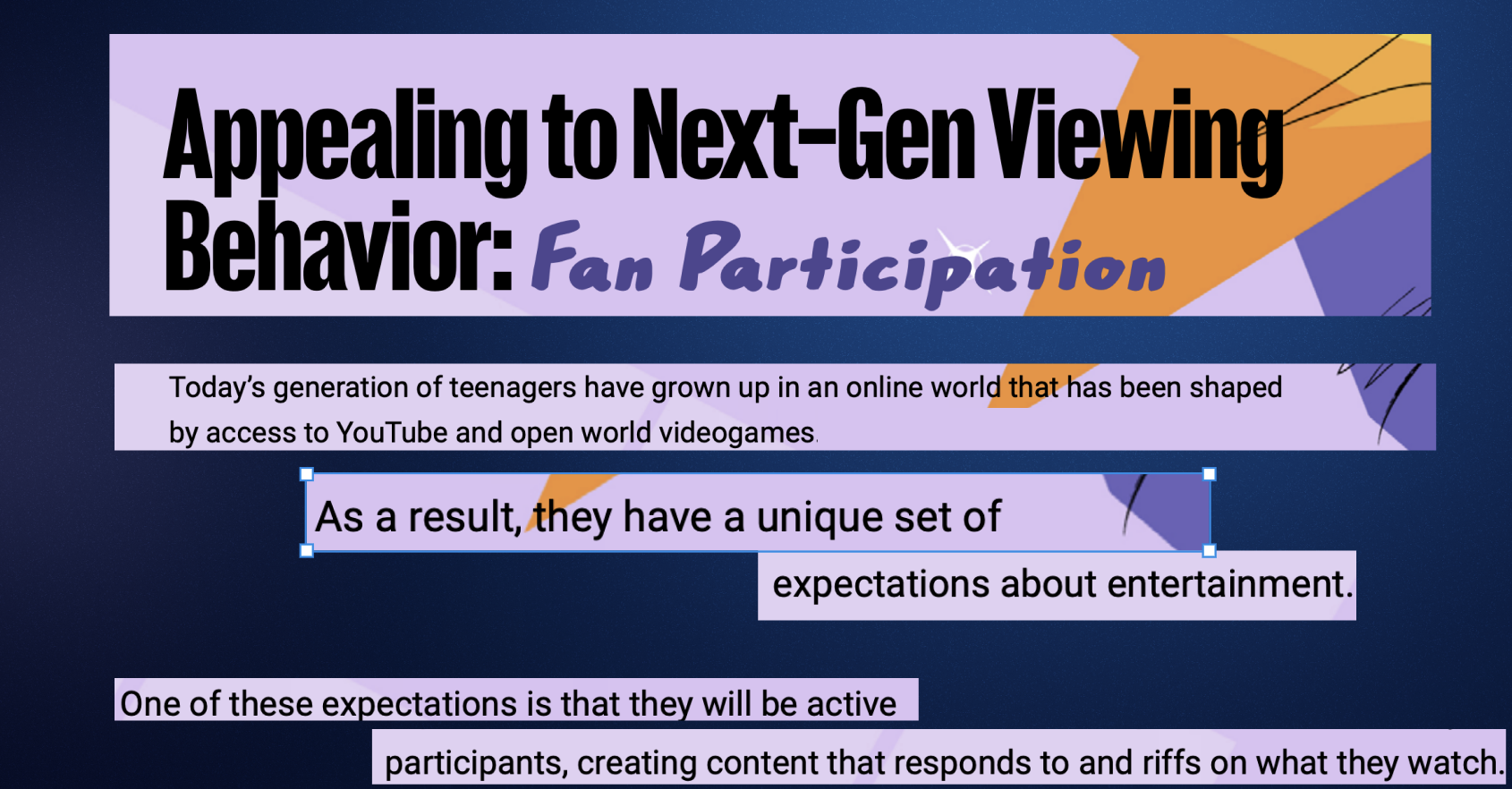
YouTube’s 2026 Culture & Trends Report underlines fan participation as a major entertainment trend:
Studio Jadu audiences have grown tremendously on YouTube alone. That is exciting, but what interests us more is what we can learn about the relationship between an original character and the people who choose to keep coming back to it. And there are many questions to answer:
These questions will matter enormously in the next era of entertainment.
It used to be that all you needed was to build the reach, and get more views. This approach, in the best of times, squanders much of the potential upside, and given the glut of content that will compete for monetization, we will be facing a monetization environment that is far from “the best of times.” So what is an artist to do?
I spent years building products that monetized creator content at YouTube and TikTok, and I learned a few lessons:
And now, with the explosion in content that AI makes possible, traditional impression-saturation models will be even more under pressure. That doesn't mean those models will disappear. But it means creators need more options.
This is where an engaged fandom shows its value once again. By enabling artists to build characters that viewers love and stories that they engage with, we help the artists build fandoms that multiply the reach and depth of the story. Those fandoms are also the most effective agents of value delivery in the monetization step. And we are building products that harvest that value for artists, their fandom, and partners.
That is why we think about production, distribution, and monetization as three parts of the same problem: How to build beloved, enduring franchises that deliver economic value to the creators in this new era.
In fact, we think about production, distribution, and monetization as a loop:
Then the cycle starts again. That loop is the product we’ve spent the last several months building toward.
We are still early. There is a lot we haven’t figured out yet, and a lot more we need to build.
But our vision is clear, and our ambition larger.
We want an independent artist with an extraordinary idea to have access to capabilities that once existed only inside the largest entertainment companies without relinquishing creative control to GenAI. We want them to bring their vision to life, and see the rewards of it.
We are building the future of entertainment with artists and fans. Not instead of them.
Over the coming weeks, we’re going to share more about the individual pieces we’ve built, what we’re seeing from the creators using them, and what we’re learning about where entertainment is headed.
by Miquel Farré
by Masoud Loghmani
by Disha Gupta
For the past several months, we’ve been pretty quiet about what we’ve been building at Studio Jadu.
That was intentional.
There is no shortage of people talking about what AI might do for entertainment, with a lot of excitement about how the latest GenAI models create amazing spectacles with ease. While “production” may be at the forefront for most, we’re focusing on the business of entertainment. In this post, we’ll talk about how the biggest challenge, and the biggest opportunity, lies in rethinking the entire process end to end: from concept to production to distribution to monetization..
We’ve invested significant time working alongside creators to build, learn, rethink, and rebuild, so we are able to shape the future of entertainment to not only give creators control over their stories, but also a good fighting chance to get those stories to audiences.
One thing has been clear to me since we started Studio Jadu:
AI is going to change much more than how entertainment gets produced.
For most of the history of animation, bringing an original character or world to life required an enormous amount of capital, specialized labor, and infrastructure. That meant countless great ideas never made it past the idea stage.
AI changes those economics dramatically.
An independent artist can increasingly do things that once required an entire studio. That is a profound shift! But it doesn’t automatically produce a better entertainment ecosystem. In some ways, it creates an entirely new set of problems.
Production is simply where the disruption is easiest to see first. But as someone who spent years in monetization of entertainment, building products that generate revenue from and for creators, I always look at the end-game: how will we build an enduring and sustainable business for all stakeholders, first and foremost for the artists whose creativity fuels the entire ecosystem? That North Star led us to critical decisions about how we shape Studio Jadu’s offering.
Let’s dive in.
A lot of the AI conversation today revolves around creation, e.g. Which model produces the best video? Which workflow is fastest? How much cheaper can production become?
Those are useful questions. They’re just not the only ones that matter.
Because after you make something, you still have to get somebody to care about it. And if dramatically more people can create dramatically more content, attention becomes even scarcer. This is the part of the AI entertainment transition that I think gets underestimated.
Democratizing production does not automatically democratize distribution.
A creator can make a beautiful character and still have no idea how to find the first thousand people who care about it. They can make a great episode and never turn a viewer into someone who comes back for the next one. They can accumulate views without building a fandom. And they can build a fandom without having a meaningful way to participate in the economic value that fandom creates.
Those are not separate problems to us.
They are the problems we started Studio Jadu to solve.
We’ve been building Jadu around three connected parts of the entertainment business: production, distribution, and monetization.
On the production side, our goal is to empower artists to bring their story to life with as much creative control as possible. We don’t believe GenAI can originate stories that will resonate with viewers. Artists can. We believe that our limitations, our very mortality, is what makes the most beautiful art possible.
Machines don’t get that. Audiences do.
This is more than just a philosophical musing. We are running a business that backs artists and their stories. And we believe that slop will have no commercial value, regardless of how cheap it is to produce it. So we want artists who have a strong point of view, great taste, and are ready to sweat over the details. To serve them, we’ve built a system that gives them the control they need to create original characters in amazing new worlds that audiences will fall in love with.
AI can generate, but only artists originate.
Every decision in the design of our production workbench, called AIDA (short for AI Director’s Assistant), was made with that principle in mind. For example:
But production is just the beginning. Once a creator has something worth watching, another challenge begins.
Studio economics were historically built around scarcity. There were relatively few organizations capable of producing and distributing high-quality entertainment at scale.
That world is disappearing.
When production becomes abundant, distribution becomes more important, not less. And we think distribution itself is going to change.
The most interesting creators don’t simply accumulate viewers. They create characters and worlds people want to return to. Over time, those audiences become communities. And the most engaged members of those communities don't necessarily want to remain passive consumers. They want to participate. That idea has been part of Jadu’s DNA since the beginning.
YouTube’s 2026 Culture & Trends Report underlines fan participation as a major entertainment trend:
Studio Jadu audiences have grown tremendously on YouTube alone. That is exciting, but what interests us more is what we can learn about the relationship between an original character and the people who choose to keep coming back to it. And there are many questions to answer:
These questions will matter enormously in the next era of entertainment.
It used to be that all you needed was to build the reach, and get more views. This approach, in the best of times, squanders much of the potential upside, and given the glut of content that will compete for monetization, we will be facing a monetization environment that is far from “the best of times.” So what is an artist to do?
I spent years building products that monetized creator content at YouTube and TikTok, and I learned a few lessons:
And now, with the explosion in content that AI makes possible, traditional impression-saturation models will be even more under pressure. That doesn't mean those models will disappear. But it means creators need more options.
This is where an engaged fandom shows its value once again. By enabling artists to build characters that viewers love and stories that they engage with, we help the artists build fandoms that multiply the reach and depth of the story. Those fandoms are also the most effective agents of value delivery in the monetization step. And we are building products that harvest that value for artists, their fandom, and partners.
That is why we think about production, distribution, and monetization as three parts of the same problem: How to build beloved, enduring franchises that deliver economic value to the creators in this new era.
In fact, we think about production, distribution, and monetization as a loop:
Then the cycle starts again. That loop is the product we’ve spent the last several months building toward.
We are still early. There is a lot we haven’t figured out yet, and a lot more we need to build.
But our vision is clear, and our ambition larger.
We want an independent artist with an extraordinary idea to have access to capabilities that once existed only inside the largest entertainment companies without relinquishing creative control to GenAI. We want them to bring their vision to life, and see the rewards of it.
We are building the future of entertainment with artists and fans. Not instead of them.
Over the coming weeks, we’re going to share more about the individual pieces we’ve built, what we’re seeing from the creators using them, and what we’re learning about where entertainment is headed.
by Miquel Farré
by Masoud Loghmani
by Disha Gupta
For the past several months, we’ve been pretty quiet about what we’ve been building at Studio Jadu.
That was intentional.
There is no shortage of people talking about what AI might do for entertainment, with a lot of excitement about how the latest GenAI models create amazing spectacles with ease. While “production” may be at the forefront for most, we’re focusing on the business of entertainment. In this post, we’ll talk about how the biggest challenge, and the biggest opportunity, lies in rethinking the entire process end to end: from concept to production to distribution to monetization..
We’ve invested significant time working alongside creators to build, learn, rethink, and rebuild, so we are able to shape the future of entertainment to not only give creators control over their stories, but also a good fighting chance to get those stories to audiences.
One thing has been clear to me since we started Studio Jadu:
AI is going to change much more than how entertainment gets produced.
For most of the history of animation, bringing an original character or world to life required an enormous amount of capital, specialized labor, and infrastructure. That meant countless great ideas never made it past the idea stage.
AI changes those economics dramatically.
An independent artist can increasingly do things that once required an entire studio. That is a profound shift! But it doesn’t automatically produce a better entertainment ecosystem. In some ways, it creates an entirely new set of problems.
Production is simply where the disruption is easiest to see first. But as someone who spent years in monetization of entertainment, building products that generate revenue from and for creators, I always look at the end-game: how will we build an enduring and sustainable business for all stakeholders, first and foremost for the artists whose creativity fuels the entire ecosystem? That North Star led us to critical decisions about how we shape Studio Jadu’s offering.
Let’s dive in.
A lot of the AI conversation today revolves around creation, e.g. Which model produces the best video? Which workflow is fastest? How much cheaper can production become?
Those are useful questions. They’re just not the only ones that matter.
Because after you make something, you still have to get somebody to care about it. And if dramatically more people can create dramatically more content, attention becomes even scarcer. This is the part of the AI entertainment transition that I think gets underestimated.
Democratizing production does not automatically democratize distribution.
A creator can make a beautiful character and still have no idea how to find the first thousand people who care about it. They can make a great episode and never turn a viewer into someone who comes back for the next one. They can accumulate views without building a fandom. And they can build a fandom without having a meaningful way to participate in the economic value that fandom creates.
Those are not separate problems to us.
They are the problems we started Studio Jadu to solve.
We’ve been building Jadu around three connected parts of the entertainment business: production, distribution, and monetization.
On the production side, our goal is to empower artists to bring their story to life with as much creative control as possible. We don’t believe GenAI can originate stories that will resonate with viewers. Artists can. We believe that our limitations, our very mortality, is what makes the most beautiful art possible.
Machines don’t get that. Audiences do.
This is more than just a philosophical musing. We are running a business that backs artists and their stories. And we believe that slop will have no commercial value, regardless of how cheap it is to produce it. So we want artists who have a strong point of view, great taste, and are ready to sweat over the details. To serve them, we’ve built a system that gives them the control they need to create original characters in amazing new worlds that audiences will fall in love with.
AI can generate, but only artists originate.
Every decision in the design of our production workbench, called AIDA (short for AI Director’s Assistant), was made with that principle in mind. For example:
But production is just the beginning. Once a creator has something worth watching, another challenge begins.
Studio economics were historically built around scarcity. There were relatively few organizations capable of producing and distributing high-quality entertainment at scale.
That world is disappearing.
When production becomes abundant, distribution becomes more important, not less. And we think distribution itself is going to change.
The most interesting creators don’t simply accumulate viewers. They create characters and worlds people want to return to. Over time, those audiences become communities. And the most engaged members of those communities don't necessarily want to remain passive consumers. They want to participate. That idea has been part of Jadu’s DNA since the beginning.
YouTube’s 2026 Culture & Trends Report underlines fan participation as a major entertainment trend:
Studio Jadu audiences have grown tremendously on YouTube alone. That is exciting, but what interests us more is what we can learn about the relationship between an original character and the people who choose to keep coming back to it. And there are many questions to answer:
These questions will matter enormously in the next era of entertainment.
It used to be that all you needed was to build the reach, and get more views. This approach, in the best of times, squanders much of the potential upside, and given the glut of content that will compete for monetization, we will be facing a monetization environment that is far from “the best of times.” So what is an artist to do?
I spent years building products that monetized creator content at YouTube and TikTok, and I learned a few lessons:
And now, with the explosion in content that AI makes possible, traditional impression-saturation models will be even more under pressure. That doesn't mean those models will disappear. But it means creators need more options.
This is where an engaged fandom shows its value once again. By enabling artists to build characters that viewers love and stories that they engage with, we help the artists build fandoms that multiply the reach and depth of the story. Those fandoms are also the most effective agents of value delivery in the monetization step. And we are building products that harvest that value for artists, their fandom, and partners.
That is why we think about production, distribution, and monetization as three parts of the same problem: How to build beloved, enduring franchises that deliver economic value to the creators in this new era.
In fact, we think about production, distribution, and monetization as a loop:
Then the cycle starts again. That loop is the product we’ve spent the last several months building toward.
We are still early. There is a lot we haven’t figured out yet, and a lot more we need to build.
But our vision is clear, and our ambition larger.
We want an independent artist with an extraordinary idea to have access to capabilities that once existed only inside the largest entertainment companies without relinquishing creative control to GenAI. We want them to bring their vision to life, and see the rewards of it.
We are building the future of entertainment with artists and fans. Not instead of them.
Over the coming weeks, we’re going to share more about the individual pieces we’ve built, what we’re seeing from the creators using them, and what we’re learning about where entertainment is headed.
by Miquel Farré
by Masoud Loghmani
by Disha Gupta